Eye-Rolling the FED.

Over the years, I’ve become much more aware of the intrinsic hope that bad news will help the market. Investors are sure the FED will be there at their darkest hour, so the forward guidance and interest rate rising suggestion are not really changing their minds. ‘The Market believes the Fed will bail them out.’

Aside from listening to talking heads such as Janet Yellen and Ben Bernanke be wrong time after time after time, the market learned in 2008 that if the problem gets big enough, the treasury will turn on the money printing machines. The FED has yet to convince them otherwise. So when value disappears from the market, investors resort to the ‘Greater Fool Theory’ — to buy something today ‘hoping’ to sell it for more tomorrow. ‘Buying the dip’ has become the rally cry of this sector, and this sector is huge. a 10% drop makes everything feel cheap and creates false bottoms in market corrections.

As we have written about many times, the amount of money the FED has printed HAS to create inflation; there is no avoiding this. The FED used every arrow the their quiver to keep control of it, but throw in a black-swan like COVID and all the planning in the world couldn’t stop this.

If interest rates continue to raise as the FED indicates they will, the market will react negatively. Without any true value in the market, the conservative investors will take the inflated gains and look for safer options. They just have to begin to believe there is no bailout coming. The FED has to continue to raise rates. This is when many investors should consider ‘getting up from the table’ and cashing in. When will all this happen? Clearly I don’t know. But all signs are flashing red that there is a problem.

If you are holding general market investments and want to talk about your positions, please feel free to give me a call. Risk analysis in a portfolio will make a huge difference once this market pops.

Sincerely,

Phillip Haydn Connors

Investment Adviser

Value Financial Advisers, Inc

3600 S. Beeler St

Suite # 300

Denver, CO 80237

Office: (303) 770-3030

Fax: (303) 773-9122
We’re Back…

After an extended COVID initiated break from this blog, the current condition of the economy and financial markets make it feel prudent to resume commentary regarding the many Headlines and opinions of today’s environment.

As I sit here on Sunday, I am reading Janet Yellen’s statements regarding a possible recession (No recession, just a ‘slow-down’) and I can’t help but wonder when has she ever been right? See her commentary regarding transitory inflation, then her admitting she was wrong, yet we still allow her to resume her duties as one of the most important people in the financial world? It’s as if she’s almost surprised printing TRILLIONS of dollars would eventually create inflation. Neither her, nor Bernanke or Greenspan before her were ever right (or perhaps honest) with what their economic outlook was. Yet their wreck-less dovish policies and actions have helped put the US into more debt than ever in history.

The Real-estate bubble and the Dot.com era crashes were eschewed away until they could no longer ignore the obvious errors in their statements. Yet we still let them to go back to work? Is a recession coming? I sure think so, but I can’t say for sure. But I know I wouldn’t trust Janet Yellen with her predictions.

We see bubbles in almost every major area of the market. Fixed incomes are having their worst year ever, and the FED still faces a 9% + inflation number, (much higher if food, gas and food were calculated) so they will have to continue to raise interest rates. This does not help an overpriced stock market (yes, we see the market as very overpriced still), nor those who already hold their fixed incomes, or those who want to sell their house. If you are looking for some assistance on how to navigate these areas, and discuss areas we are seeing real value for our clients, please do not hesitate to call me.

Phillip Haydn Connors

Investment Adviser

Value Financial Advisers, Inc

3600 S. Beeler St

Suite # 300

Denver, CO 80237

Office: (303) 770-3030 Ext 1

Fax: (303) 773-9122

Holiday Weekend?

There is no doubt that time has just been blending together. Since going to a modified schedule in our office for social distancing, I often have no idea what day it is unless my phone or computer are near by. It wasn’t until my drive to work this morning did I become aware of the upcoming holiday. I know this is not how I planned to start my summer, so perhaps I was ignoring the holiday since the pools wont be opening this weekend and parties and BBQ’s are still a ways out. Now I am just imagining being as bored as we have been, but in much hotter weather.

Recently, anybody paying attention could sense that people are becoming a bit looser in their activities. Parks are opening up, the pickle-ball courts by my house are always full, more kids are playing in groups and more houses are having guests as obvious by the increase in cars parked on the street. Traffic is still very pleasant compared to 3 months ago; likely because the amount of people not going to work or those who have realized they can stay home from work have gotten out of the way. I feel it is going to stay this way for a long time.

Nationally, we are in the midst of an enormous debate about what to do next. Their is no clear answer. There are enormous economic consequences of staying closed, not to mention the mental and physical health of keeping people closed-in and interfering with their routines it took years to develop. This virus is taking it’s toll on most of us in ways we could not have imagined 10 weeks ago, and many business owners will never recover from the impact of this shut down. Even entire industries will be forever altered by the stay at home orders; watch what happens to the service industry for dine-in restaurants.

Of course, the other side refers to the health and safety. No matter your fear of the virus, I’d be willing to wager you don’t want to get it. I’m not afraid of the flu, but I don’t want to get that either. But for many, this virus is too much to handle. Those of older age or have underlying health issues see this virus very differently, so I can understand their concerns with things opening without a vaccine or even proper testing that is accurate and easily accessible. Even in our office, we have these opposing sides of the argument.

As I write this, the S&P is down around 12% from it’s high point in February. It should be a lot worse. The true economic impact of this virus cannot be fathomed at this point. Had the FED not signaled every intent to bail out everybody, it would have been. But the word Trillion is now the new Billion. Policies are quickly thrown together, full of loop holes and obstacles that make it hard to monitor and hard to get the money into the hands of people who need it. There is A LOT more of this to come. Unemployment will be astronomical for a long time while jobs that evaporated due to the crisis leave workers looking elsewhere. We do not think the market has seen it’s darkest days yet.

If you would like to discuss what this long term economic outlook will mean to your portfolio, or just have general questions about your situation, please feel free to give me a call.

Phillip Connors Investment Adviser Value Financial Advisers, inc. 303-770-3030

Wish We Had Storage

Apologies about the single post this week. Our office has gone to social distancing, meaning we are all spending considerably less time in the office and work remotely from home. This has taken some getting use to since we go to great lengths to protect our client’s non public information, additional steps are required when working off site to authenticate access to that information. On top of home schooling my daughter for the remaining part of the year, the extra time I’ve had has been less than I would like recently.

Most importantly, I’ve also tried to touch base with most of my client’s during this time, which has occupied quite a bit of my in-office time when their files are easiest to access.

I wanted to address the oil situation that occurred earlier this week, as this is the first time in History this event happened. If one didn’t understand the basics of oil, it probably made no sense. ‘How can oil be negative $ 35 a barrel?’ Ill try to keep it simple.

Oil is sold in contracts. Basically they are promissory notes to deliver a certain amount of barrels by a specific date. With oil demand very high ‘Pre-Covid,’ drillers were pulling out as much as they could in order to sell it through these contracts. But Covid crushed oil demand with it’s impact on travel, trade, and the global economy ,so these companies had massive amounts of oil that nobody needs. Because of this very low demand, they have to sell it at a negative (pay somebody) in order to get somebody to take it off their hands since they do not have the storage needed for this oil. How long will this excess continue? And where will the oil be stored with supply well exceeding demand?

If you would like to talk about the long term outlook for oil based on this recent demand crush, or have other questions or concerns regarding investments you’d like to discuss, feel free to give me a call. I’m not sure I’ve ever been so busy between work and my home-life, but I try to always make myself available for clients or readers who’d like to chat.

Phillip Connors Value Financial Advisers, Inc. (303) 770-3030 phillip@valuefin.com

No RMD in 2020

Just a quick note to all our readers. All Required Minimum Distributions (RMDs)
have been waived for the year 2020. This also applies to Inherited IRA’s. You can of course take money out if you wish too, but you will not be required to at risk of penalty as in previous years.

If you’d like to discuss how this impacts your income situation or your portfolio in general, please feel free to give me a call.

Phillip Connors Investment Adviser (303) 770-3030 Phillip@valuefin.com

Paid More to Not Work?

The new Unemployment payments have begun, and they are making some workers jealous. No matter how much your unemployment benefit claim is currently, all unemployed workers will be getting a $ 600 additional weekly payment for the next 4 months. That is equivalent to $ 15 dollars an hour for a 40 hours a week on top of whatever benefit they were receiving before this increase.

On a national level, the average state gives out around $ 463 dollars a week for unemployment per claim. That number just increased by $ 600. So $ 1,063 a week, or approximately $ 55,000 a year if you want to look at in annually. The additional benefit alone is worth $ 10,800 to those who are unemployment during the whole period ($ 600 X 18 weeks.) There is a lot of incentive for lower earners to stay unemployed; at least until the additional benefits wear off, if they ever do. More helicopter money.

For many essential workers, minimum wage or slightly above is the going rate. Let’s use the example of somebody making $ 18 an hour though. That is $ 720 a week, $ 12,960 while working until the additional benefit is set to wear off, or approximately $ 37,000 annualized that they will earn while working during the virus while the the unemployed will make noticeably more because the government just increased their benefit on top of what their payout would have been from unemployment prior to this decision. I’d probably be rooting for my job to lay me off too if I had those options to choose from.

Now it’s probably better to have a non essential job which furloughed you with the option to come back once they can begin to work again. You get time off, to be with your kids, learn a language, learn an instrument, sleep in, garden, read books,home projects etc. It’s like a trial run at retirement. Income is coming in, and just the ‘to-do’ list to take care of.

This is not good policy. It just isn’t. I understand they had to do something, do it fast, and they aren’t done yet, but this is not the precedent you want to set. Benefits are usually designed to help maintain their lifestyle, not improve it. This will create additional dependency on the system and entitlements, both of which just puts this country into more debt. The debt will have to be dealt with at some point.

If you are concerned with the amount of money being printed, or loose policy passing that feels like they just threw spaghetti at the wall to see what sticks, feel free to give me a call. We can talk about ways to possibly protect your portfolio’s purchasing power while the money machines are turned on.

Phillip Connors Investment Adviser (303) 770-3030 http://www.valuefinancial.com

Am I a Buyer yet?

Long before the Coronavirus, we have been fairly obvious about our concerns with the General Stock Market pricing. Virtually all fundamentals of ‘Value’ investing were being ignored with record high prices and record low (at the time) interest rates. Savers were being punished with anemic fixed income returns, so more money poured into the stock market for people looking for better returns. The market was already ‘in the red’ as Nascar fans would say, then the engine seized up when the Coronavirus hit.

I have had numerous emails from clients asking if now is the time to buy. I’ve been very conservative with their portfolios over the last couple of years, so wanting to be buyers is a totally rational reaction. Though I did increase their equity exposure a bit, I still have not fully vested their portfolios. I am not ready to ‘back the truck’ up yet.

To start, I am never not a ‘buyer.’ I just am critical of which investments I think offer a long term good value, usually meaning I would buy the whole company if I had the money to do so. Good values are harder to find when the market is significantly overpriced, but we are looking for them. Warren Buffet was also holding more cash than ever prior to this virus, signaling he also saw fewer value opportunities available in this current market.

With all areas of the market being impacted by this virus, we are looking at distressed areas and businesses to see if we can find the diamond in the rough. These sorts of market reactions can tend to hit all investments, so it does make the pricing more interesting on the investments we would use to build a client’s portfolio. But as with any volatile market, you have to be prepared for the investment to initially keep falling after you buy it, so the time frame needs to be longer for stock investments. As in 2008, when investors run for the hills, they sell their quality and lower quality assets all the same. We want to buy the quality assets while the crowd is selling them.

We are also increasing our positions in investments that work to protect purchasing power of our client’s accounts once the money printing starts. The amount of stimulus needed to counter this virus will be astronomical. Helicopter money, tax reductions, etc, not to mention all the industries that will require a bailout to stay in business. The total amount will be enormous.

If you’d like to discuss adjusting your portfolio to reduce your risk and protect the purchasing power of your account while the money printers are turned on, feel free to give me a call @ (303) 770-3030.

Phillip Haydn Connors Investment Adviser Phillip @valuefin.com

Money Money Money Money… Money

First, let me apologize for the delay between posts. Truth be told, me and my girlfriend ended up moving ourselves across town by ourselves, with no help on the packing or unpacking side. Our help cancelled on us the morning we were making the move because of the Coronavirus, so it was me and her versus 4 bed rooms and a basement. 13 hours later, our last box made it into the garage of the new house, and we were exhausted.

It’s wasn’t just carrying the furniture that was tough. Not having any of our friends and family to help on either side to organize and decorate really does underline how much socializing impacts our lives. We have already met almost all of our neighbors (from a safe distance since they are all out walking) and quickly identifying who has little kids that go to school with my daughter for future play dates. Hopefully sooner than later.

While away, and with very limited access to the internet while moving and until the cable was installed, I saw the market put on a slight late-quarter rally, but still finished as one of the worst quarters in U.S Stock market history. Not surprised based on the outbreak of Coronavirus virtually crippling the global economy; I was a little surprised the quarter wasn’t even worse. Some potentially positive news about Coronavirus treatments gave the market some brief confidence, but that seems to have leveled off lately.

The FED and congress are throwing everything it can at it so far, with little success of calming investors fears that it can buy it’s way out of this. They have begun to use the word ‘Trillion’ as the new normal, which it very well may be. Nobody has any idea how long this will go, and how much it would cost, but the 2 trillion that has been approved will be just the tip of the iceberg. Turn on the money printers.

Helicopter money is coming. It won’t be enough, and doesn’t put money in the hands of all the people that need it, but there still is going to be a lot of it. Other programs, such as small business loans that do not have to be paid back if used to pay employees allows small businesses to keep their payroll running while people are at home. Also, a few mortgage and auto loan companies have already begun to offer their borrowers a deferment of up to 90 days on their payments, and I expect others will follow suit. They have to keep blood flowing in the system, so give people money. It really is their only choice. The longer this goes, the more ways they will come up with to give cash to spenders to keep the system alive.

If you are worried about the debt getting out of control, the value of your money being printed away by the enormous stimulus coming this country’s way, or about the health of the US Economy and how they will impact your portfolio, feel free to give me a call. There are investments that can possibly help protect against those scenarios.

Phillip Connors Investment Adviser (303) 770-3030 Phillip@valuefin.com http://www.valuefinancialadvisers.com

That Happened Fast

In approximately one month of trading, the US Stock Market has returned to it’s value before Donald Trump’s presidency began. 3 years and approximately 2 months of growth has been erased due to a ‘Black Swan’ event that now dominates every headline and talk radio show on right now. Very concerning of course aside from the illness itself is the unknown of how long these impacts will have on our lives.

Most, if not all of us have been already impacted fairly significantly due to this virus. My daughter’s school went to online classes for the foreseeable future. She is in 1st grade, so needless to say, the school and parents were not prepared for this. My significant other is a personal trainer at a gym, and we found out Monday that her services have been suspended until further notice. Each day, thousands learn their jobs have been put on hold while we figure out how to deal with COVID-19. Parents have to stay home with their kids taking online classes, which partially explains the run on milk at the Walmart by my house. What started as a story on page 9 a few weeks ago, this virus has quickly become a factor in everything we do.

The FED is doing all they can; the problem is there isn’t much they can do. They’ve lowered interest rates as far as they can. They are going to be helping buy stressed assets in the corporate bond world. They’ve signaled the need to help airlines, travel, small business etc. Also noteworthy, they’ve announced intentions to start sending money directly to consumers so those unexpectedly impacted by the Coronavirus can pay their bills and buy their necessities while the Government decides what to do next.

These intentions haven’t calmed the market down though. The volatility of this market shows how scared people are of holding the investments they hold. The more bad news that comes out, the more likely investors are willing to lock in the cash and run. These moves by the FED have tempered off possible large corrections in the past, but with the global economy shut down and commerce all but stopped, their tools may not be enough. The worst part (financially) is how expensive all this will be. Who do we bail out? Who don’t we bail out? How much money do we give away to consumers? Etc But most importantly, “Where are we going to get it?’

If you are having similar concerns about how this market can impact your situation, please feel free to give me a call.

Phillip Connors Investment Adviser (303) 770-3030

Here Comes the Stimulus.. But Can it Work?

Stimulus stimulus stimulus. But how? And where do we get the money?

The FED has been very mediocre when stimulating the economy since 2008. I know that stock markets (until recently) were at record levels, unemployment was low etc. I am not saying they were unable to somewhat ‘goose’ these numbers with their policies, but the amount of money they had to spend and manipulate in order to create this perceived growth and strong economy would show their ideas were poorly executed. Yet up to this point the market has always believed they would bail them out.

And the FED will, if it can figure out how to do that. But the FED’s biggest weapon, the ability to lower interest rates, is almost out of ammunition. Their last rate drop only worried the market, and that market has already priced in the next anticipated rate cut of 25 basis points in their next meeting.

Today the FED announced a 500 Billion repo program to open up liquidity for smaller businesses and short term borrowers. The market reacted very positively, erasing almost 1200 points of losses in the matter of a few minutes. Yet 40 minutes later, the market had erased all the positive momentum from the FED’s announcement. The market finished down 10%, the worst day since 1987.

The market has seen all the measures offered by the FED at this point to be insufficient to overcome the fears of the Coronavirus and it’s impact on global economies. Every day that impact is growing. No more NBA basketball, no March Madness, no St. Paddy’s day parades, no more spring training baseball, no more Hockey; all of those announcements made in the last 24 hours. The overall impact of this pandemic will take time to truly quantify it’s impact to both the markets and our daily lives, but things will likely get worse before they get better. What actions will the FED take next in order to curb this fear?

An Oldie but a goodie

We don’t think the FED or Trump really have the tools left to stimulate this economy giving the current conditions. At this pace, airlines will need a bailout, travel will need a bailout, and tons of small businesses who relies on public consumption will need a bailout. The FED has very little room left to drop interest rates. The corporate bond market is in a lot of trouble as well.

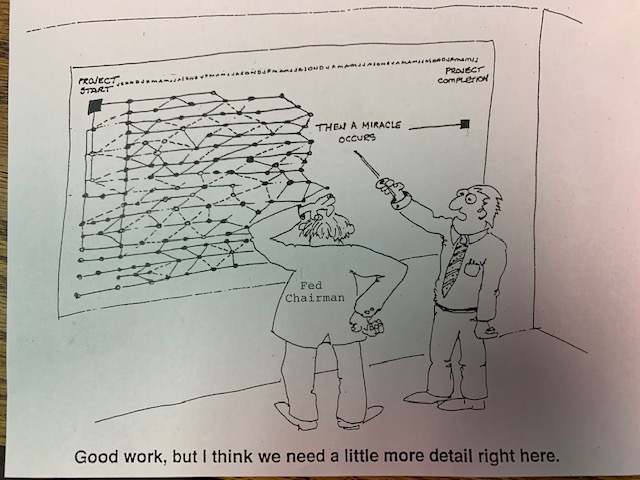
To be clear, we would not want to be the chair of the FED. The actions of the FED have spurred all time highs in the market, and until recently, most headlines were about our growing and stable economy. But those actions have created issues with overpriced stocks and artificially low interest rates. The FED has created one of the largest bubbles in stock market history, they can’t just let it crash. Investors seemed content with the overpricing as long as interest rates stayed low and the world kept on turning. Enter an unforeseen circumstance, such as the Coronavirus and and the environment changes dramatically.

Risk level is one way an investor can hedge against these types of events. Asset allocation reviews can help investors identify which areas they are taking risk at, and is that risk appropriate for their situation? Feel free to call us @ (303) 770-3030 to review your accounts. Also please feel free to visit our website @ http://www.valuefinancialadvisers.com to review our previous quarterly newsletters expressing concern about the market and what is coming next. (Before the Coronaviurs)